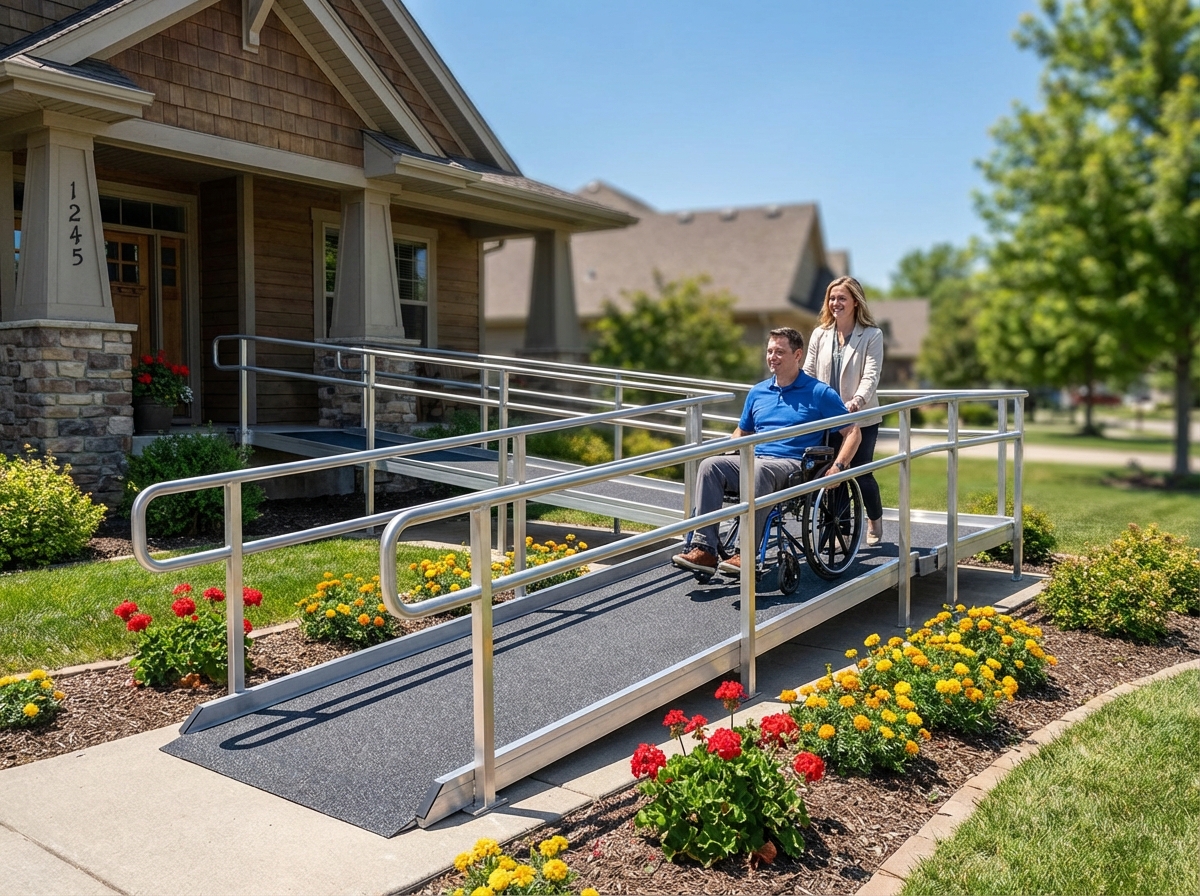
Planning a safe, compliant home entrance ramp starts with the correct slope. This article explains ADA slope rules, how to measure rise, use a ramp slope calculator, and practical design choices for manual and power wheelchair users. You’ll get clear calculations, material and permit guidance, accessibility funding options, and a checklist to plan a durable, comfortable ramp for everyday mobility.
Why ramp slope matters and ADA basics
The slope of a ramp is the most critical factor for anyone using a wheelchair. It determines if a person can enter their home safely. It determines if they can do so without help. A ramp that is too steep becomes a wall. It creates a risk of tipping backward. It causes extreme fatigue for manual chair users. It can even burn out the motors on expensive power chairs. When we talk about ramp planning, the angle of the incline is where every conversation must start. This is not just about convenience. It is about physics. It is about the limits of human strength. It is about the mechanical capabilities of mobility devices.
The 1 to 12 Standard
The Americans with Disabilities Act (ADA) Standards for Accessible Design provide a specific rule for slopes. This is known as the 1 to 12 ratio. This means for every 1 inch of vertical rise, you must have 12 inches of horizontal ramp run. If you have a porch that is 24 inches high, you need 24 feet of ramp. In mathematical terms, this is an 8.33 percent grade. This specific angle is the maximum steepness allowed for new construction in public spaces. It is the baseline for safety. Most people can manage this incline. It allows for a controlled ascent. It allows for a safe descent. You can use an ADA Standards Ramp Calculator to see how this ratio changes based on your specific height requirements.
Alternative Slopes for Better Access
While 1 to 12 is the legal limit, it is not always the best choice for every person. Some people find an 8.33 percent grade too difficult to climb.
- The 1 to 16 Ratio
This creates a 6.25 percent slope. It is much easier for manual wheelchair users who have limited upper body strength. It provides a more gradual climb. The downside is the length. A 24 inch rise would require 32 feet of ramp. This takes up more space in a yard. It increases the cost of materials. - The 1 to 20 Ratio
This is a 5 percent slope. At this level, the ramp feels more like a gentle walkway. It is the gold standard for independence. Many building codes stop classifying the structure as a ramp once the slope is 1 to 20 or flatter. This often means you do not need handrails. It requires a significant amount of space. A 24 inch rise would need 40 feet of ramp.
Manual chair users often struggle with the 1 to 12 ratio over long distances. Power chair users might handle a 1 to 12 slope easily. However, a gentler slope reduces wear on the battery. It reduces wear on the drive system. You can check different options using a Wheelchair Ramp Slope Calculator to compare how much space each ratio will occupy on your property.
Technical Requirements for Ramp Runs
The ADA Standards (2010) Section 405 outlines very specific technical requirements. These rules prevent a ramp from becoming a long, exhausting marathon.
Maximum Rise
A single ramp run cannot have a rise greater than 30 inches. If your total rise is 40 inches, you cannot build one continuous 40 foot ramp. You must break it up. You need a level landing between the two sections. This gives the user a place to rest.
Minimum Clear Width
The ramp must have a clear width of at least 36 inches. This measurement is taken between the handrails. It is not just the width of the wood or metal platform. It is the usable space for the wheelchair.
Landings
Landings are required at the top and the bottom of every ramp run. They must be at least 60 inches long. They must be at least as wide as the ramp. If the ramp changes direction at a landing, the landing must be at least 60 inches by 60 inches. This provides enough room for a person to turn their chair.
Cross Slope
The surface of the ramp must be level from side to side. The maximum allowable cross slope is 1 to 48. This is a 2 percent grade. This is just enough to allow water to drain off. It is not enough to make a wheelchair pull to one side. A steep cross slope is dangerous. It can cause a chair to veer off the edge.
Handrails and Edge Protection
Safety features are mandatory once a ramp reaches a certain size. ADA Section 505 covers these details.
Handrail Triggers
You must install handrails on both sides if the ramp rise is higher than 6 inches. You also need them if the horizontal run is longer than 72 inches.
Handrail Height
The top of the gripping surface must be between 34 inches and 38 inches above the ramp surface. The handrails must be continuous. They must not rotate within their fittings.
Edge Protection
Ramps and landings must have a way to keep wheelchairs from slipping off. This is usually a curb or a barrier. It must be at least 4 inches high to prevent the passage of a standard caster wheel. This prevents the small front wheels of a chair from dropping over the side. You can find more about these specs at an Incline Calculator page.
Legal Standards versus Private Homes
The ADA Standards apply to public buildings. They apply to commercial facilities. They do not strictly apply to private single family homes. However, these standards are the result of decades of research. They are the best practice for safety. Many homeowners make the mistake of building a steep ramp to save money. They end up with a structure that is unusable. Local building codes often adopt ADA language. Your city might require a permit for a ramp. They might inspect it to ensure it meets the 1 to 12 rule. Always check with your local building department. Some state laws are even stricter than the federal ADA. Using an Ramp Calculator can help you stay within these legal and safety boundaries.
Common Misunderstandings
Homeowners often confuse the terms rise, run, and slope.
Rise is the vertical height you need to climb.
Run is the horizontal distance the ramp covers.
Slope is the relationship between the two.
A common error is thinking a 10 foot ramp is enough for a 20 inch rise. That would be a 1 to 6 ratio. That is twice as steep as the ADA limit. It is a recipe for an accident. Another mistake is forgetting the landings. A 20 foot ramp needs more than 20 feet of yard space because of the 5 foot landings at each end. Total space planning is essential. You can use a Ramp Calculator to visualize the total footprint before you start construction.
How to measure rise and use a ramp slope calculator
Accurate measurements serve as the foundation for any safe home accessibility project. Before you buy materials or look at modular systems, you must determine the exact vertical rise of your entrance. This measurement is the total height the ramp needs to overcome, starting from the finished ground surface up to the top of the door threshold. You should not just measure to the porch floor. The threshold itself often adds an inch or two that can create a dangerous trip hazard if the ramp ends too low.
How to measure the vertical rise
To get a precise number, you need a long straightedge, a carpenter level, and a tape measure. Place one end of the straightedge on the highest point of the threshold where the wheelchair will cross. Extend the straightedge out horizontally over the area where the ramp will begin. Use the level to ensure the straightedge is perfectly flat. Measure the vertical distance from the bottom of the straightedge down to the ground. If the ground is sloped or uneven, you must measure to the specific spot where the ramp will eventually land. Measuring straight down at the door might give you a rise of 12 inches, but if the sidewalk 15 feet away is 3 inches lower, your actual rise is 15 inches. This difference significantly changes the required ramp length.
Choosing the right slope for the user
The 1:12 ratio is the standard baseline for the Americans with Disabilities Act. This means for every 1 inch of vertical rise, you need 12 inches of ramp length. While this is the legal maximum for public buildings, it is often too steep for many home users. A person using a manual wheelchair with limited upper body strength will find a 1:12 slope exhausting or even impossible to climb without help. Power wheelchairs and scooters handle 1:12 easily, but steep inclines can still feel unstable or cause the anti-tip wheels to catch on the transition.
The 1:16 to 1:20 range
If the user plans to navigate the ramp independently in a manual chair, a gentler slope is much safer. A 1:16 ratio (1 inch of rise for every 16 inches of run) or a 1:20 ratio (1 inch of rise for every 20 inches of run) provides a much more manageable incline. The trade-off is the physical footprint and the cost. A 1:20 ramp is nearly twice as long as a 1:12 ramp. This requires more yard space and significantly more building materials. You must balance the physical ability of the user against the available space on your property.
Calculation formulas and examples
Calculating the ramp run is a simple multiplication task once you have your rise and your target ratio. The run is the horizontal distance the ramp covers. To find the run in inches, multiply the rise by the second number in your ratio. For a 1:12 slope, multiply the rise by 12. For a 1:16 slope, multiply by 16.
Run (inches) = Rise (inches) x Slope Ratio
Run (feet) = Run (inches) / 12
If you have a 10 inch rise and want a 1:12 slope, the math is 10 times 12, which equals 120 inches. Dividing 120 by 12 gives you exactly 10 feet of ramp. If you prefer to think in percentages, a 1:12 slope is an 8.33 percent grade. You calculate this by dividing 1 by 12 and multiplying by 100. A 1:16 slope is a 6.25 percent grade, and a 1:20 slope is a 5 percent grade. Using a Ramp Calculator can help verify these numbers before you start cutting wood or ordering metal sections.
Sample calculations for common rises
The following table shows the required ramp length in feet for common household rises at different slope ratios. These figures represent the ramp run only and do not include the length of necessary landings.
| Vertical Rise | 1:12 Slope (Standard) | 1:16 Slope (Gentle) | 1:20 Slope (Easiest) |
|---|---|---|---|
| 6 inches | 6 feet | 8 feet | 10 feet |
| 9 inches | 9 feet | 12 feet | 15 feet |
| 12 inches | 12 feet | 16 feet | 20 feet |
| 18 inches | 18 feet | 24 feet | 30 feet |
| 24 inches | 24 feet | 32 feet | 40 feet |
Factoring in landings and direction changes
A ramp is rarely just a straight line from the door to the driveway. You must include flat landings at the top and bottom of every ramp. ADA standards require these landings to be at least 60 inches long. If the door swings outward toward the ramp, the top landing must be large enough to allow the user to pull back and open the door without rolling down the slope. This usually requires a 60 inch by 60 inch square area.
Direction changes
If your yard is not long enough for a straight run, you will need to incorporate a turn. This is often done with a “switchback” or an “L-shaped” design. Every time the ramp changes direction, you must provide a level landing. These intermediate landings must be at least 60 inches by 60 inches to allow a wheelchair to make a 90-degree or 180-degree turn safely. These landings add significant length to the total footprint of the project. A 20 foot ramp with one 5 foot turn landing actually occupies 25 feet of linear space.
Maximum single run rise
You cannot build one continuous slope for a very high rise. ADA rules state that a single ramp run cannot exceed a 30 inch rise. If your total rise is 45 inches, you must break the ramp into at least two sections with a level resting landing in between. This prevents the user from gaining too much speed when going down or becoming too exhausted when going up. Even if you are not strictly following ADA for a private home, this 30 inch rule is a vital safety feature for preventing accidents.
Using a web calculator for planning
When using an online Omni Calculator or a similar tool, you should have three main inputs ready. First is the total rise in inches. Second is your desired slope ratio. Third is the unit of measurement you prefer for the output. A good calculator will provide more than just the total length. It should tell you the total run, the number of individual ramp sections required based on the 30 inch rise rule, and the minimum number of landings needed.
Interpreting the results
When a calculator gives you a result like 22.4 feet, always round up to the next standard size. If you are building with wood, you will likely buy 8 foot, 10 foot, or 12 foot boards. If you are using a modular aluminum system, sections usually come in 2 foot increments. Planning for a slightly longer ramp is always better than ending up with a slope that is too steep because you tried to save 6 inches of space. The output should give you a clear idea of the total footprint so you can check for obstacles like trees, utility meters, or property lines before construction begins.
Practical design choices: materials, permits, and funding
Once you have used a Wheelchair Ramp Slope Calculator to determine the necessary length, the focus shifts to the physical structure. A safe ramp requires more than just the right incline. You must plan for a minimum clear width of 36 inches between handrails. This space allows for most manual and power wheelchairs to pass without catching wheels or armrests. If the user has a particularly wide bariatric chair, increasing this to 42 or 48 inches is a smart move.
Safety Features and Hardware
Handrails and Guardrails
As stated, any ramp with a rise greater than 6 inches needs handrails on both sides. These should be mounted between 34 and 38 inches above the ramp surface. The grip surface must be smooth and easy to grasp, usually with a diameter between 1.25 and 2 inches. Handrails should extend at least 12 inches beyond the top and bottom of the ramp segments to provide stability before the user starts or finishes the incline.
Edge Protection
To prevent wheels from slipping off the edge, you need curbs or toe boards. These should be at least 4 inches high. This is a critical safety feature for power chair users who might lose traction or manual users who might veer slightly off course.
Thresholds and Transitions
The point where the ramp meets the door threshold is often a tripping hazard. Use transition plates or rubber threshold ramps to create a flush surface. Even a half inch vertical lip can stop a front caster wheel and cause a tip. For the bottom transition, ensure the ramp blends smoothly into the driveway or sidewalk to avoid a jarring bump.
Surfacing and Drainage
Water or ice makes a ramp useless. If you use wood or composite, leave small gaps between planks for drainage. For aluminum, look for serrated or punched floors that let water through. You can add non slip tape or grooved surfaces to existing ramps. Some homeowners prefer a grit-infused paint or porous decking to maintain traction in the rain.
Comparing Construction Materials
Choosing the right material impacts your budget and how much work you will do over the next ten years. Each option has a different lifecycle and price point.
| Material | Pros | Cons | Approximate Cost |
|---|---|---|---|
| Prefabricated Aluminum | Fast install, no rust, modular, high resale value. | Industrial look, can be noisy, high upfront cost. | High ($150 to $250 per foot) |
| Treated Wood | Low cost, looks natural, easy to customize. | Rots over time, needs staining, can be slippery. | Low ($100 to $150 per foot) |
| Composite Decking | Low maintenance, many colors, very durable. | Expensive, can get hot in sun, heavy. | Medium to High ($150 to $200 per foot) |
| Concrete | Permanent, highest weight capacity, very quiet. | Permanent, requires excavation, expensive. | High ($200 plus per foot) |
Foundation and Weather Management
A ramp is only as stable as its base. For wood or concrete, you need footings that reach below the frost line to prevent heaving. Aluminum modular ramps often sit on concrete pads or heavy duty patio stones. Anchoring the ramp to the house and the ground prevents shifting during heavy winds or usage. In cold climates, snow management is vital. Avoid using rock salt or calcium chloride on aluminum as it can cause corrosion. Use a magnesium chloride-based melt or sand instead. If you live in a high snow area, consider a heated mat system under the ramp surface or a roof over the structure to keep the path clear.
Permits and Professional Help
Most municipalities require a building permit for a permanent ramp. Check with your local building department before buying materials. They will look at your slope calculations and safety features. Typical inspections happen after the footings are set and once the final structure is finished. If the project involves complex turns or high elevations, hiring a licensed contractor or an accessibility specialist is recommended. They understand the nuances of local codes and can ensure the structure is legally compliant as well as safe.
Funding Avenues in the U.S.
The cost of a ramp can be a barrier, but several programs help cover these expenses. Eligibility usually depends on veteran status, disability level, or income.
- VA Grants
Veterans may qualify for the Specially Adapted Housing (SAH) grant or the Home Improvements and Structural Alterations (HISA) grant. These can cover thousands of dollars for home access. - Medicaid Waivers
Many states offer Home and Community Based Services (HCBS) waivers. These programs pay for home modifications that allow people to stay in their homes instead of moving to a facility. - Vocational Rehabilitation
If a ramp is needed for you to get to work or school, state vocational rehab agencies might provide funding. - Nonprofit Grants
Organizations like Habitat for Humanity or Rebuilding Together often have local chapters that build ramps for seniors and people with disabilities. - Tax Incentives
The federal Disabled Access Tax Credit (IRS Form 8826) is available for small businesses, but homeowners can often deduct the cost of a ramp as a medical expense if it is medically necessary. Check with a tax professional about home modification tax incentives in your state.
Practical Next Step Checklist
- Measure the total vertical rise from the ground to the door threshold.
- Check local building codes for specific residential ramp requirements.
- Use a Ramp Calculator to find the total run and number of landings.
- Decide on a material based on your budget and maintenance ability.
- Get at least three quotes from contractors or modular ramp suppliers.
- Apply for grants or financing before signing any contracts.
- Submit your permit application to the city or county.
Frequently Asked Questions
Do ADA rules apply to private single family homes
Federal ADA standards technically govern public spaces and commercial buildings rather than private residences. You are not legally forced by federal law to meet a one to twelve slope ratio inside your own house. However, most local building departments adopt these standards into their residential codes. Following these rules protects your safety and maintains the resale value of your property. If you ever sell the home, a non compliant ramp might need to be removed or replaced. You should check with your local building office to see if they require a specific slope for residential occupancy permits. For more details on these standards, you can view the Wheelchair Ramp Slope Calculator resources which explain the safety logic behind the rules.
How steep can a ramp be inside my house
Indoor ramps often face space constraints that make a standard one to twelve slope difficult. While the ADA recommends one inch of rise for every twelve inches of length, some residential situations allow for a steeper one to eight or one to ten slope. This is only acceptable for very short rises of three inches or less. If the person using the ramp has a manual wheelchair and limited upper body strength, a steep slope becomes a tipping hazard. Power wheelchairs can often handle steeper inclines, but you must check the owner manual for the specific grade limit of the motor. Safety experts suggest sticking to the one to twelve standard whenever possible to prevent accidents.
How wide should a ramp be for a power wheelchair
The minimum clear width for any wheelchair ramp is thirty six inches between the handrails. For power wheelchairs, this can feel quite narrow. Power chairs are often wider and heavier than manual chairs. They also require more room to maneuver the joystick without hitting the side rails. A width of forty two or forty eight inches provides a much more comfortable experience. This extra space prevents the wheels from rubbing against the edge protection or handrails. If the ramp includes a turn, the landing must be large enough to accommodate the full length of the power chair plus the turning radius. You can use a Ramp Calculator to visualize how width affects the overall footprint of your project.
Do I always need handrails and what are the exceptions
You must install handrails on both sides if the ramp rise is greater than six inches or if the horizontal run is longer than seventy two inches. Handrails provide essential stability for people who are walking and prevent wheelchairs from slipping off the edge. The only common exception is a very short threshold ramp used to bridge a door sill. These small wedges usually do not require rails. Handrails must be continuous and smooth to the touch. They should be mounted between thirty four and thirty eight inches above the ramp surface. If children will use the ramp, adding a second lower rail is a smart safety choice.
What are the rules for landing size and spacing
Landings are the flat platforms at the top, bottom, and any turn in the ramp. They must be at least sixty inches long and at least as wide as the ramp itself. If the ramp changes direction at the landing, the platform must be at least sixty inches by sixty inches. This five by five foot space allows a wheelchair user to stop and turn without the risk of rolling backward. You also need a landing every thirty feet of horizontal run. Long ramps without breaks cause physical exhaustion for manual chair users. These flat spots act as resting points and safety buffers.
Can I build a modular ramp myself
Modular aluminum ramps are designed for relatively easy assembly. Many homeowners choose to install these themselves to save on labor costs. These systems use interlocking sections and adjustable legs. You will need a level, a drill, and a socket set. The most difficult part is ensuring the ground is stable and level where the legs rest. If the soil is soft, you might need to place concrete pavers under the feet to prevent sinking over time. While DIY is possible, you should have a second person to help with the heavy lifting of the larger sections. Always follow the manufacturer instructions to maintain the product warranty.
Do I need a building permit for a home ramp
In most jurisdictions, a permit is required if the ramp is a permanent structure attached to the house. This includes wood ramps with footings and concrete ramps. Some cities exempt temporary or modular aluminum ramps that do not require permanent footings. You should call your local building department before starting work. They will check for property setbacks and ensure the ramp does not block emergency exits. Failing to get a permit can result in fines or issues when you try to sell your home. A permit also ensures that a professional inspector reviews the safety of the construction.
How much does a typical ramp cost and what affects the price
A typical home ramp can cost anywhere from one hundred to two hundred fifty dollars per linear foot. A thirty foot ramp might range from three thousand to seven thousand five hundred dollars. Wood is often the cheapest material upfront but requires the most maintenance. Aluminum modular ramps are more expensive but last longer and have a high resale value. Labor is a significant factor in the total price. If your yard has a steep grade or requires significant excavation, the cost will increase. Custom features like decorative railings or integrated lighting also add to the final bill.
Are wheelchair lifts a better option than ramps
Vertical platform lifts are excellent when you have a high rise and very little yard space. A ramp for a sixty inch rise would need to be sixty feet long. A lift only takes up a five by five foot area. However, lifts are more expensive and require electricity. They also need regular mechanical maintenance and can fail during a power outage. Ramps are generally more reliable because they have no moving parts. If you have the space, a ramp is usually the preferred choice for ease of use and long term durability. Lifts are best reserved for tight urban lots or very high porches.
Where can I find funding or grants for a ramp
Several programs help homeowners cover the cost of accessibility modifications. The Department of Veterans Affairs offers grants like the Specially Adapted Housing grant for eligible veterans. Many states have Medicaid waivers that pay for home environmental transitions. You can also look into the Rural Housing Repair Loans and Grants program through the USDA if you live in a qualifying area. Non profit organizations like Habitat for Humanity or local Centers for Independent Living often have volunteer programs to help with labor. The IRS may also allow you to deduct the cost of the ramp as a medical expense if it is medically necessary.
How do I maintain a ramp during the winter
Winter maintenance is vital for preventing slips. If you have an aluminum ramp, never use rock salt or calcium chloride because these chemicals can corrode the metal. Use sand for traction instead. For wood or composite ramps, you can use specialized ice melt products that are labeled safe for those materials. Shovel the ramp frequently to prevent snow from packing down into ice. Some homeowners install heated mats under the ramp surface to keep it clear automatically. Always check that the handrails are clear of ice so the user has a firm grip at all times.
Final results and next steps
The standard ratio of one to twelve remains the most important starting point for any home ramp project. This measurement means that for every inch of vertical rise, the ramp must have twelve inches of horizontal length. While this is the maximum steepness allowed under the Americans with Disabilities Act for public spaces, it is often the bare minimum for residential safety. Many homeowners find that a slope of one to fifteen or even one to twenty provides a much better experience. Manual wheelchair users often struggle with the physical demand of a one to twelve incline over long distances. A gentler slope reduces the risk of tipping backward. It also makes the descent much easier to control during wet or icy weather.
The Measurement and Calculation Checklist
Before buying materials or calling a contractor, you need a precise set of numbers. Start by measuring the total vertical rise from the ground to the top of the door threshold. Do not just measure to the porch floor. The ramp must meet the actual entry point of the house. Use a long, straight board and a carpenter level (or a string level) to extend the height of the porch out over the landing area. Measure the distance from the bottom of that board to the ground. This ensures you account for any natural slope in your yard. If the ground where the ramp ends is lower than the ground near the house, your total rise will be higher than expected. You should also map out the available “footprint” in your yard. Note the location of permanent obstacles like large trees, gas meters, or underground utility lines. These factors will dictate whether you can build a straight ramp or if you need a switchback design with intermediate landings.
A Practical Seven Day Action Plan
Moving a project from the planning stage to construction requires a structured approach. You can complete the preliminary work within a single week if you follow these steps.
- Day One. Measure the total vertical rise and the available horizontal space in your yard. Use a string level for accuracy.
- Day Two. Choose your slope ratio based on the physical abilities of the primary user. Decide if a one to twelve or a gentler one to sixteen incline is necessary.
- Day Three. Draw a rough sketch of the ramp layout. Include all necessary landings and turns. Calculate the total square footage.
- Day Four. Contact your local building department. Ask if a permit is required for a temporary modular ramp versus a permanent wooden structure. Inquire about property line setbacks.
- Day Five. Request two different quotes. Ask one company for a quote on a professional aluminum modular system. Ask a local licensed contractor for a custom wood or concrete estimate.
- Day Six. Research funding options. Look into VA housing grants if applicable. Check with state Medicaid waiver programs for home accessibility modifications.
- Day Seven. Compare the quotes and funding. Review the maintenance requirements for each material. Make your final selection.
Sources
- Ramp Calculator: Slope, Rise, & Run Estimator – LS Building Products — The Ramp Calculator makes it easy to plan, check, and share accurate ramp specifications. Find out your rise:run ratio, slope, and more.
- Ramp Calculator — For example, ADA requires a minimum slope of 1:20 and a maximum of 1:12. Ensure the landing area is at least 1.525 meters (60 inches) long. For further building …
- Incline Calculator | Determine Ramp Length for Accessibility — We start you off with the ADA standard ratio of 1:12 (every 1" of rise requires 12" of ramping), however, refer to your equipment's owner guide for acceptable …
- Ramp Length Calculator – Reliable Ramps — The 1:4 ratio has a 12° Slope and is recommended to be the max slope for strong assistance with manual chairs. 1:4, 0.33 Feet ; The 1:3 ratio has a 15° Slope and …
- ADA Standards Ramp Calculator – Wheelchairs in Motion — In each case, the maximum rise allowed is 30 i n 30 in ( 760 m m 760 mm). These three ADA ramp slope values are preset in our ramp calculator. If existing sites …
- Wheelchair Ramp Slope Calculator | ADA Slope Percentage — Building an ADA compliant ramp requires careful attention to ensure your slope is safe and accessible. Use our slope calculator to find your measurements.
- Handicap Ramp Slope and Length Calculator – Upside Innovations — As a guide, the ADA ramp requirements are 1 foot of ramp for every inch of rise for a 4.8° incline. Ramp Length Calculator. Enter elevation height in Inches.
- Ramp Length Calculator – Roll-A-Ramp — Generally Recommended Slope Angles: 4.8-degree: This is Americans With Disabilities Act-compliant – click here for more information about Roll-A-Ramp and …
EMPTY