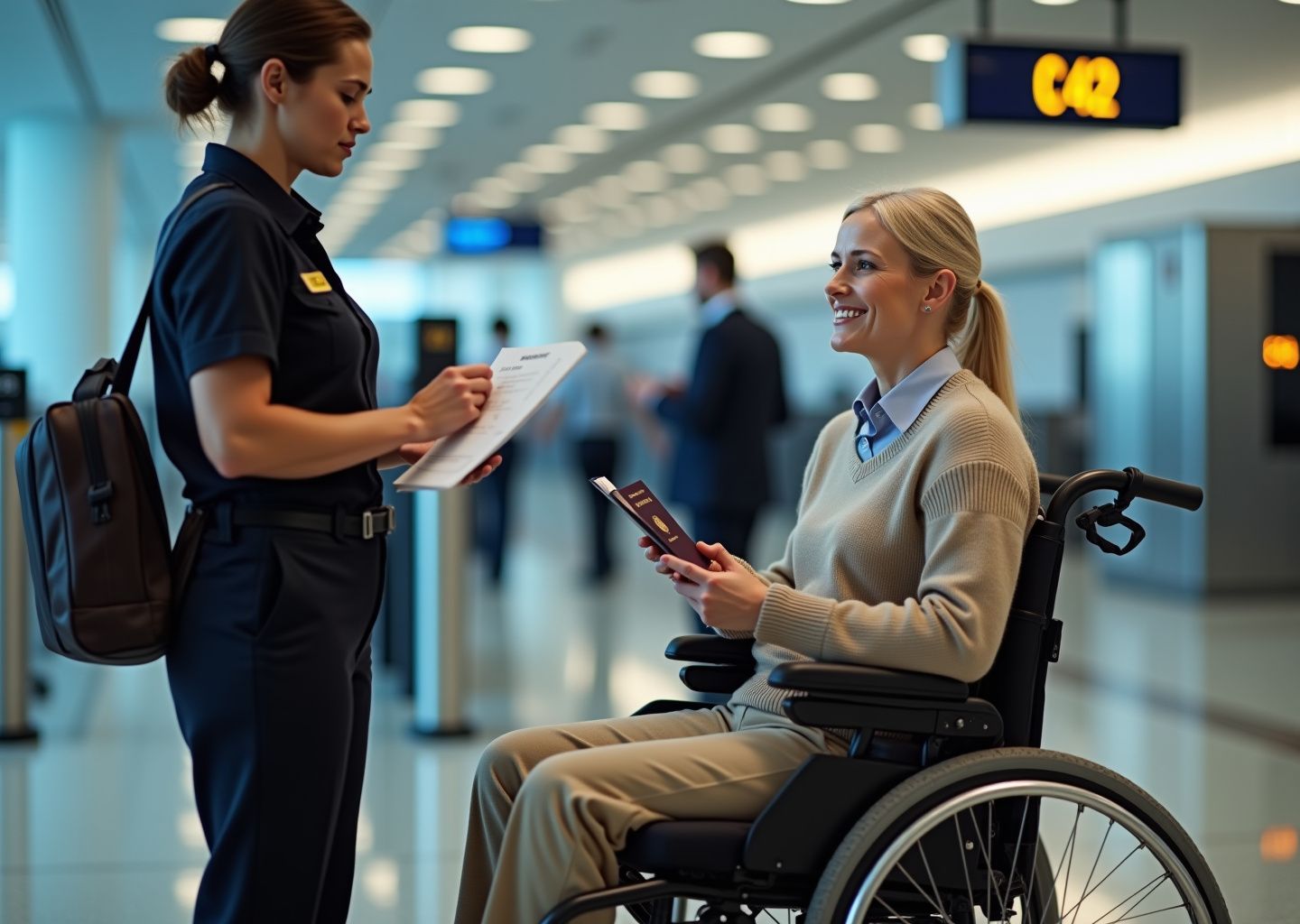
Traveling with a wheelchair raises unique questions about airport security, screening procedures, and airline responsibilities. This article explains TSA Cares, your legal rights under U.S. aviation disability rules, practical steps for preparing manual and power wheelchairs, what happens at security checkpoints, and how to protect your mobility device so your journey is safer and less stressful.
What TSA Cares Is and What Rights Protect You at the Airport
Navigating airport security can feel overwhelming, but knowing your rights and the resources available makes a world of difference. The key is understanding two things: the support system in place to help you and the laws that protect you. Let’s break down what TSA Cares is and how the Air Carrier Access Act (ACAA) ensures your journey is as smooth as possible.
What is TSA Cares and How Can It Help You?
TSA Cares is a dedicated helpline for travelers with disabilities, medical conditions, or other circumstances that may require special assistance during the security screening process. Think of it as your direct line to the TSA for pre-travel coordination. Its purpose is to ensure you have a predictable and accommodating experience at the checkpoint. By contacting them in advance, you can arrange for a Passenger Support Specialist (PSS) to meet you at security. This specialist is trained to provide on-the-spot assistance, answer questions, and guide you through the screening process with dignity and efficiency.
You should call TSA Cares at least 72 hours before your flight. This gives them enough time to coordinate with the security staff at your departure airport. When you call, you can explain your specific needs. For example, you can request a private screening room if you prefer not to be screened in public. You can also discuss any medical equipment you’re traveling with, like a feeding tube or an ostomy bag, so the officers are prepared. The official contact information is available on the TSA website. Always verify the current phone number and online request form at tsa.gov/travel/passenger-support/tsa-cares before your trip, as details can change.
Your Legal Rights Under the Air Carrier Access Act (ACAA)
While TSA Cares handles the security checkpoint, your rights throughout the rest of the airport and on the plane are protected by the Air Carrier Access Act (ACAA). This federal law makes it illegal for airlines to discriminate against passengers based on disability. The U.S. Department of Transportation (DOT) is responsible for enforcing these rules. You can find the full text and consumer guides on the DOT’s website at transportation.gov.
Under the ACAA, airlines have several key responsibilities regarding your mobility aid. First, they must transport your wheelchair or scooter free of charge. This applies whether you check it at the ticket counter or gate-check it. Airlines are required to provide “reasonable accommodations” to ensure you can travel. This includes providing assistance with boarding, deplaning, and making connections. For instance, if you need help moving from your wheelchair to an aisle chair and then to your airplane seat, the airline must provide trained personnel to assist you. They are also required to offer pre-boarding to give you extra time to get settled.
Let’s consider a practical scenario. You arrive at the gate in your personal power wheelchair. Airline staff should allow you to remain in your chair until it’s time to board. At the jet bridge, you will transfer to a narrow aisle chair. Your wheelchair will be taken to be stowed in the aircraft’s cargo hold. This is known as “gate-checking.” It’s crucial that you provide clear instructions on how to operate and handle your specific device, which we’ll cover in the next section.
What to Do When Things Go Wrong
Despite these protections, problems can arise. An airline might refuse an accommodation, or your wheelchair could be damaged during transit. If you encounter an issue with airline staff, your first step should be to ask for the airline’s Complaint Resolution Official (CRO). Every airline is required to have a CRO available, either in person or by phone, at all times. The CRO is trained in ACAA regulations and has the authority to resolve disability-related issues on the spot.
If your mobility aid is damaged, you must act immediately. Before leaving the airport, take detailed photos of your wheelchair from all angles to document its condition. If it’s damaged upon arrival, take photos of the damage before moving it. Go straight to the airline’s baggage service office, file a damage report, and get a printed copy for your records. If the airline’s immediate response is inadequate, use clear escalation language. For example: “Per DOT regulations, I require an immediate resolution, including a suitable loaner chair, while you arrange for the repair or replacement of my device.” If the CRO cannot resolve the problem to your satisfaction, you have the right to file a formal complaint with the DOT. Filing a complaint holds airlines accountable and helps the DOT track patterns of non-compliance. For more information, you can visit the Department of Transportation’s page on Wheelchair and Guided Assistance.
Preparing Your Manual and Power Wheelchair Before Travel
A smooth journey begins long before you arrive at the airport. Proper preparation of your wheelchair not only protects your device but also streamlines your interactions with airline staff and TSA agents. Taking these steps can significantly reduce stress and prevent last-minute complications.
First, document everything about your wheelchair. Use a tape measure to get the exact dimensions: height, width, and length. Weigh the chair, noting the total weight and the weight of the heaviest piece if it disassembles. Write this information down and keep it handy for your call with the airline. Take clear, well-lit photos of your wheelchair from all angles, paying close attention to any existing scuffs or unique features. These photos are invaluable if you need to file a damage claim later. It’s also wise to create a simple label with your name, phone number, and email address and securely attach it to the frame of your chair.
Next, prepare the physical device for handling. Remove all loose items that could fall off or get lost in transit, such as cushions, side guards, cup holders, and storage bags. Pack these in your carry-on or checked luggage. If parts cannot be removed, secure them with zip ties or removable tape. If your wheelchair is collapsible, make sure you know exactly how to fold or disassemble it. It’s helpful to have printed, step-by-step instructions, perhaps with pictures, to give to the ground crew. You can even laminate this guide and attach it to the chair. Consider bringing a small repair kit with essential tools and spare parts, like tire patch kits or extra hardware, for any minor issues that might arise upon arrival.
Understanding battery regulations is critical for power wheelchair users. The rules differ based on battery type and size.
- Lead-Acid Batteries (Non-spillable): These include gel and absorbed glass mat (AGM) batteries. If the battery can remain in the wheelchair, airline staff will disconnect the terminals and tape them to prevent short circuits. The battery must be securely attached to the chair. If it must be removed, it will be placed in a strong, rigid box provided by the airline and stowed in the cargo hold.
- Lithium-Ion Batteries: These are subject to strict FAA and IATA rules based on their watt-hour (Wh) rating. While you should always verify the most current regulations with your airline before flying, the general guidelines are:
- Installed Battery: The battery can remain installed in your wheelchair. There is no watt-hour limit for the installed battery, but you must inform the airline of its type.
- Spare Batteries: You are typically allowed up to two spare lithium-ion batteries, which must be carried in the cabin with you. Each spare battery must not exceed 160 Wh, and for batteries between 101-160 Wh, you must get airline approval beforehand. Spares under 100 Wh generally do not require pre-approval, but always check with your airline.
To prepare spare batteries for your carry-on, you must protect the terminals from short-circuiting. You can do this by taping over the terminals, placing each battery in its own protective pouch, or keeping it in its original retail packaging. If a battery cannot be carried in the cabin due to size or airline restrictions, you will need to make alternative arrangements, such as shipping it to your destination.
Your final preparation step involves communication and documentation. At least 72 hours before your flight, call both TSA Cares and your airline’s accessibility desk. When you call the airline, use a clear script. For example, say, “Hello, I am flying on [Date] with reservation number [Number]. I will be traveling with my power wheelchair and need to add its details to my booking. The dimensions are [L x W x H], the weight is [Weight], and it uses a [Battery Type] battery. I would also like to request pre-boarding and an aisle chair for assistance.” Keep a folder with important documents, including your wheelchair’s serial number, purchase receipt, and a copy of the user manual. If you need specific accommodations like a seatbelt extension, a letter from your doctor can be helpful. When packing, keep all essential wheelchair accessories like chargers, remotes, and cushions in your carry-on bag to prevent loss or damage.
What Happens at Security and How to Protect Your Mobility Device
Navigating the TSA checkpoint can feel like the most stressful part of your journey, but knowing what to expect and understanding your rights can make all the difference. The process is designed to be thorough, but it doesn’t have to be intimidating. Your mobility device is an extension of you, and protecting it is a top priority.
The screening process begins when you approach the checkpoint. You will likely be directed to a lane that can accommodate your wheelchair. A TSA officer will explain the procedure. You will not be asked to get out of your wheelchair if you are unable to stand or walk. The screening will be adapted to you.
Here is a step-by-step look at what typically happens:
- Visual and Physical Inspection.
An officer will first look over your wheelchair. Then, they will conduct a physical inspection, which includes a pat-down of your person and a thorough check of your wheelchair. They will feel around the frame, under the seat, and inside any pouches or pockets. The seat cushion will also be inspected. This is a standard part of the process for all wheelchair users. - X-Ray for Removable Items.
Any items that can be removed from your wheelchair, like the cushion, side guards, bags, or electronic components, will be put in a bin and sent through the X-ray scanner along with your carry-on luggage. This is why it’s a good idea to remove sensitive electronics like the joystick controller yourself and place them in your carry-on bag to protect them. - Explosive Trace Detection (ETD).
This is a very common procedure. The TSA officer will use a small, dry cloth to swab various parts of your wheelchair, such as the armrests, joystick, and frame. They may also swab your hands. The cloth is then placed into a machine that analyzes it for any trace of explosive materials. This test takes only a few seconds.
You always have the right to a private screening. If you feel uncomfortable being screened in public, you can request it at any point. Simply say to the nearest TSA officer, “I would like to request a private screening room.” You are allowed to have a travel companion or family member with you during this screening.
For power wheelchair users, the handling of batteries is a key concern. The battery that is installed in your device will be inspected while it is in place. TSA officers are trained not to operate your device, so they will ask you how to power it on and off. Be prepared to show them. If you are traveling with spare batteries, especially lithium-ion ones, they must be in your carry-on baggage. These will be visually inspected and may also be swabbed as part of the ETD screening.
To minimize the risk of damage and speed up the process, a little preparation goes a long way. Before you hand your device over to anyone, take a few quick photos of it from all angles. This creates a clear record of its condition. Remove any easily detachable parts like cushions, cup holders, or phone mounts and take them with you in your carry-on. When at the security checkpoint, keep your brakes locked so the chair is stable. When handing it over to airline staff for gate-checking, you may need to unlock them or show them how to disengage the motors. Use brightly colored tape to mark fragile parts and attach a laminated tag with your name, contact information, and clear handling instructions. For foldable chairs, using zip ties or specialized transport brackets can prevent them from unfolding unexpectedly.
Always insist on gate-checking your wheelchair. Do not let airline staff persuade you to check it at the ticket counter. Politely but firmly state, “This is a custom medical device and it must be gate-checked to prevent damage. Please provide me with a gate-check tag.”
In the rare event that a TSA officer insists on disassembling part of your wheelchair for inspection, stay calm. You can say, “This is a complex medical device. I am not comfortable with it being disassembled. Is there an alternative way to screen this component?” If they must proceed, document everything. Ask for the officer’s name and for a supervisor to be present. Use your phone to record the process if you are allowed. Insist that the same officer reassembles it while you watch to ensure it is done correctly.
Frequently Asked Questions
Navigating the world of air travel with a wheelchair can feel like a maze of rules and procedures. After discussing the step-by-step screening process, let’s tackle some of the most common questions that come up. This quick-reference guide is designed to give you clear, practical answers to help you prepare.
Can TSA or an airline force me to check my wheelchair at the ticket counter?
TSA’s role is security screening, not deciding how your wheelchair is transported. The airline is responsible for stowing your device. Under the Air Carrier Access Act (ACAA), airlines cannot force you to check your personal wheelchair at the ticket counter if you want to use it in the airport. You have the right to use your own wheelchair up to the gate. For most power chairs and larger manual chairs, you will then “gate-check” it, meaning it will be loaded onto the plane from the jet bridge. Airlines are required to allow manual, folding wheelchairs in the cabin if they fit in an approved storage space. Always confirm your airline’s specific policy for in-cabin stowage when you book.
Do I need a doctor’s note to travel with my wheelchair or medical equipment?
No, you do not need a doctor’s note to travel with a personal wheelchair or other common medical assistive devices. The ACAA protects your right to travel with these items. However, if you are traveling with less common equipment or require special accommodations, like medical oxygen, a doctor’s note explaining the necessity can sometimes help clarify things with airline or TSA staff, though it is not officially required for the device itself.
Can I use my own seatbelt or postural support on the airplane?
Generally, no. Personal restraints and supports are not FAA-approved for use during taxi, takeoff, and landing. You must use the seatbelt provided by the airline. If the standard belt doesn’t fit, you can discreetly ask a flight attendant for a seatbelt extension as you board or once you are seated. They are trained to provide these and will do so without drawing attention.
What are the best practices for gate-checking my wheelchair?
Gate-checking is almost always preferable to checking your chair at the ticket counter because it minimizes the time it’s out of your possession and reduces the number of people handling it. To prepare your chair for gate-checking, remove all detachable parts you can carry on, such as the cushion, side guards, and joystick. Secure any loose cables. Attach clear handling instructions to the chair, and as we covered previously, take photos of it at the gate. When you hand it over, verbally confirm with the ground crew that you need the chair brought back to you at the jet bridge upon arrival, not baggage claim.
Does TSA PreCheck change the screening process for wheelchair users?
Yes and no. With TSA PreCheck, you likely won’t have to remove your shoes, light jacket, or laptop. However, you will still undergo a physical pat-down and your wheelchair will be thoroughly inspected and swabbed for explosive traces. It streamlines part of the process but does not eliminate the hands-on screening required for a passenger in a wheelchair.
How are service animals handled during security screening?
Your service animal will not be separated from you. You will go through the metal detector or imaging portal together, or you will be screened in a private area. The animal’s harness, leash, or vest may require inspection, but a TSA officer will not remove it without your assistance. The animal is your responsibility to control at all times.
Can I travel with my portable oxygen concentrator (POC)?
Yes, but only FAA-approved POCs are allowed on airplanes. You cannot bring personal oxygen tanks or canisters. You must have enough battery life to power the POC for 150% of your scheduled flight time, including potential delays. Always check your airline’s specific policy and notify them in advance that you will be traveling with a POC.
What if my gel or air cushion needs to be screened?
Your seat cushion is considered a medical accessory and is allowed through security. It will need to be screened, typically by X-ray. If it’s too large or you prefer not to have it X-rayed, you can request a visual and physical inspection. This will not damage the cushion.
Conclusions and Action Plan for Confident Travel
Navigating air travel with a wheelchair can feel overwhelming, but with the right preparation, it becomes a manageable, even routine, part of your journey. The key is transforming uncertainty into a predictable process. Throughout this guide, we’ve covered the rules, your rights, and the practical steps to protect yourself and your mobility device. Now, let’s pull it all together into a final action plan that empowers you to travel with confidence and peace of mind.
The most critical takeaway is this: proactive communication is your greatest tool. Contacting TSA Cares and your airline well before your travel date isn’t just a suggestion; it’s the foundation of a smooth airport experience. It shifts you from being a passive passenger to an active participant in your screening process. Equally important is thorough documentation. Your wheelchair is an extension of you, and treating it like any other valuable asset—with photos, videos, and a record of its condition—provides crucial evidence if something goes wrong. Understanding the specific rules for your wheelchair’s batteries, especially lithium-ion types, prevents last-minute surprises at the security checkpoint or gate. Remember, you have choices during screening. You are not required to be separated from your device, and you always have the right to request a private screening for any reason. Finally, should damage occur, knowing the immediate steps for documenting the issue and filing a complaint with both the airline and the Department of Transportation is essential for holding them accountable.
To make this simple, here is a prioritized checklist to run through before every trip.
Your Travel-Ready Checklist
- Contact TSA Cares.
At least 72 hours before your flight, call the TSA Cares helpline at 855-787-2227. This is your single most effective step to ensure a trained Passenger Support Specialist is available to assist you through the security checkpoint. - Confirm Battery Status and Airline Policy.
Know your battery type (e.g., lithium-ion, non-spillable) and its watt-hour (Wh) rating if applicable. Cross-reference this with your airline’s specific policy for carriage, both in the cabin and as checked baggage. Pack any spare batteries according to FAA regulations—typically in your carry-on with terminals protected. - Photograph and Document Your Device.
Before leaving home, take clear photos and a short video of your wheelchair from all angles. Pay special attention to existing scuffs, the joystick, and any custom components. This documentation is invaluable if you need to file a damage claim. - Pack a Basic Repair Kit.
Include essential tools specific to your chair, such as Allen wrenches, a small adjustable wrench, zip ties, and duct tape. This can be a lifesaver for minor issues that may arise during transit. - Arrive Early.
Give yourself at least an extra hour beyond the standard recommended arrival time. This buffer reduces stress and provides ample time for unhurried security screening, gate-checking procedures, and pre-boarding. - Know Your Screening Options.
Decide in advance if you are comfortable with a pat-down in the public screening area or if you would prefer a private screening. You have the right to request one at any time.
To help you communicate clearly and effectively, here are a few simple, one-line scripts you can adapt.
Sample Scripts for Confident Communication
- When calling TSA Cares: “Hello, I am calling to request passenger support. I am a wheelchair user traveling on [Date] from [Airport Code] on [Airline] flight [Flight Number].”
- When speaking to a TSA Officer: “I would like to request a private screening, please.” or “I need to remain in my wheelchair during the screening process.”
- When speaking to the gate agent: “I need to confirm that my wheelchair will be gate-checked and brought up to the jet bridge at my destination.”
Regulations and airline policies are subject to change. Always perform a final check of the official TSA.gov website and your airline’s accessibility page a week before you fly to verify the most current rules. Consider bookmarking these pages and the Department of Transportation’s Wheelchair and Guided Assistance page on your phone for quick access.
Finally, your experiences matter. They contribute to a larger body of knowledge that helps fellow travelers. If you encounter a new procedure, a particularly helpful resource, or an issue not covered here, consider sharing that information with online travel communities. Your feedback helps keep guides like this one relevant and ensures we can all continue to advocate for better, more accessible travel for everyone.
References
- Diabetes and Air Travel: How TSA Cares Helps You Navigate …
- Wheelchair and Guided Assistance | US Department of Transportation — Airlines are required to provide assistance to passengers with a disability as they navigate through different portions of the airport.
- Travelers with Disabilities | Yellow Book – CDC — Travelers with disabilities or medical conditions can call the TSA Cares helpline toll free at 855-787-2227, Telecommunications Relay Service …
- Feds are moving to improve airline travel for people with disabilities — Airline travel in 2025 is set to become more dignified for passengers with disabilities under a new Department of Transportation rule.